Laying Glazed Vitrified Tiles Over Concrete Screeds: Expert Guide for Swimming Pools
Technical installation specifications, substrate preparation for Concrete Slabs & Screeds, and void-free bonding protocols.


1. Engineering Context & Project Scope
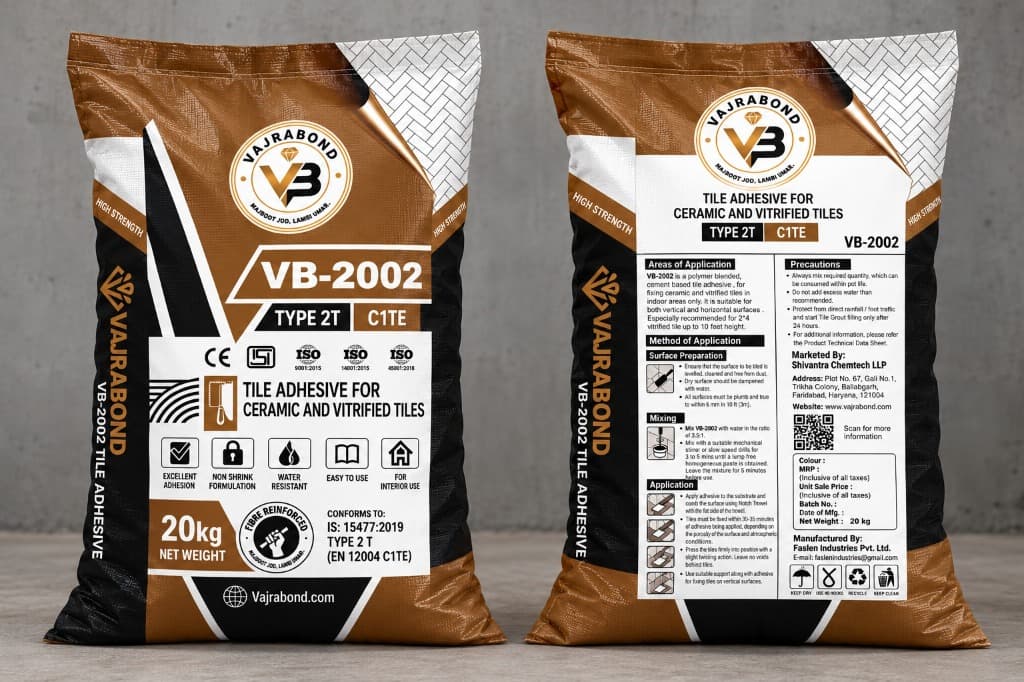
Installing Glazed Vitrified Tiles (GVT/PGVT) in Swimming Pools & Jacuzzis environments represents one of the most demanding tasks in modern tile contracting. Traditional cement-sand mortar fails catastrophically under these circumstances because Glazed Vitrified Tiles (GVT/PGVT) exhibits an exceptionally low water absorption rate (< 0.05%), preventing classical hydraulic mechanical interlock. Furthermore, Swimming Pools & Jacuzzis is subject to hydrostatic pressure, submerged conditions, and chlorine chemicals. When applying these tiles over Concrete Slabs & Screeds, structural designers, project managers, and specifiers must account for differential elastic moduli, chemical compatibility, and thermal transmission coefficients. Utilizing an engineered polymer-modified tile adhesive conforming to Type 2T / Type 3T (such as Vajra Bond VB-2002) ensures an elastic, durable bond that withstands both static loads and dynamic cyclic movements.
2. Critical Substrate Assessment: Preparing Concrete Slabs & Screeds
Over 85% of premature tile debonding and cracking originates not from defective tiles or flawed adhesive, but from deficient substrate preparation. When working over Concrete Slabs & Screeds, strict site protocols must be adhered to before applying any mortar: Remove all laitance, curing compounds, and perform mechanical scarification. In addition to baseline cleanliness, the substrate must satisfy stringent flatness tolerances. For Glazed Vitrified Tiles (GVT/PGVT), maximum permissible deviation across any 2-meter straightedge is 2mm. Where high spots exist, diamond cup grinding is required; low depressions must be leveled using polymer-modified fairing mortars at least 24 hours prior to tile fixing. Test for moisture content using an electronic impedance meter or calcium chloride dome test; relative humidity within the substrate must register below 75% to prevent osmotic moisture entrapment. Any active structural cracks in Concrete Slabs & Screeds must be bridge-reinforced with alkali-resistant glass fiber mesh and polyurethane elastomeric joint sealants.
3. Adhesive Selection & Mechanical Standards Compliance
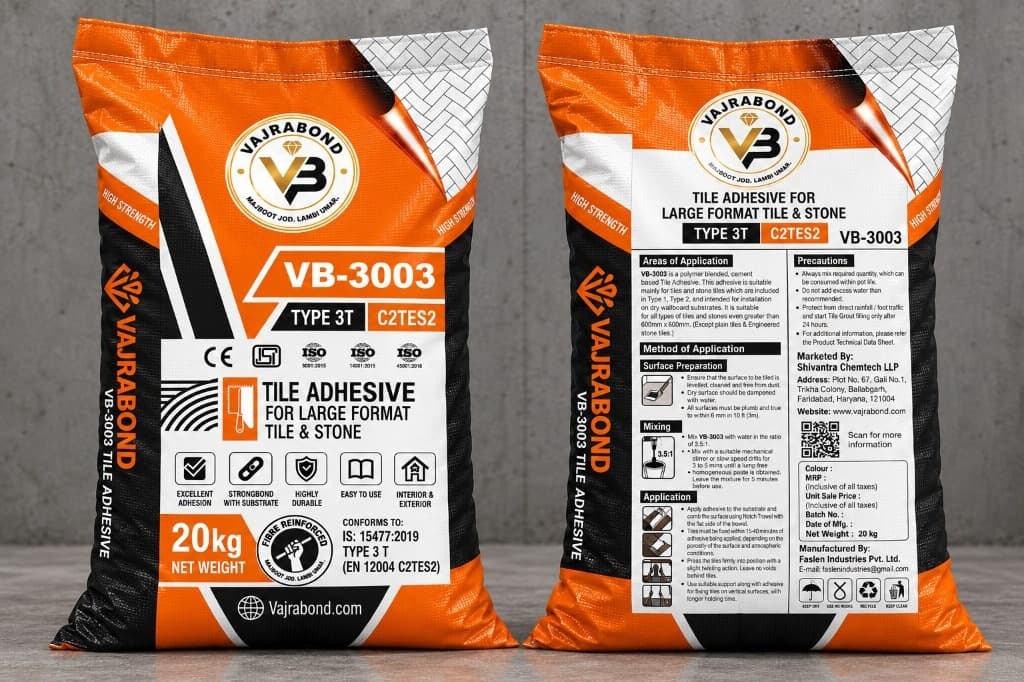
For Glazed Vitrified Tiles (GVT/PGVT) placed within Swimming Pools & Jacuzzis, selecting an adhesive meeting IS 15477:2019 and EN 12004 standards is mandatory. The adhesive bed must deliver high early tensile adhesion (>1.0 N/mm² under standard laboratory conditions) and sustain minimum 1.0 N/mm² after heat aging, water immersion, and freeze-thaw thermal cycling. Vajra Bond VB-2002 has been specifically formulated for this rigorous service class. It incorporates high-grade redispersible ethylene-vinyl-acetate (EVA) copolymers, graded silica quartz aggregates (0.1mm - 0.4mm), and cellulosics that preserve water retention even when ambient temperatures exceed 40°C. This prevents premature water loss to Concrete Slabs & Screeds, guaranteeing complete hydration of hydraulic binders and maximum chemical cross-linking against vitreous back surfaces.
4. Trowel Selection, Mortar Bed Combing & Back-Buttering Protocol
To definitively eliminate zero-staining translucent natural stone fixing, the application technique must guarantee at least 95% continuous bed coverage without air voids: 1. Trowel Geometry: Use a 10mm x 10mm square-notched stainless steel trowel for floors, or an 8mm x 8mm trowel for vertical surfaces. 2. Wetting the Substrate (Keying Coat): Apply a thin, tight skim coat using the flat side of the trowel firmly into Concrete Slabs & Screeds. This mechanically keys polymers into microscopic surface pores. 3. Directional Combing: Comb the mortar bed in straight, parallel ridges. NEVER use circular, swirling, or fan strokes. Straight ridges allow trapped air to evacuate cleanly when the tile is pressed down. 4. Back-Buttering (Butter-Floating): For all installations of Glazed Vitrified Tiles (GVT/PGVT), spread a flat 1mm skim coat of adhesive directly onto the back face of every single tile before setting. This eliminates dead air pockets behind ribs and guarantees 100% monolithic adhesive transfer.
5. Mitigating Zero-Staining Translucent Natural Stone Fixing & Movement Joints
The primary failure mechanism in this configuration involves grey cement minerals leaching through porous natural crystals. To permanently overcome this risk, execution must combine pure white high-grade polymer adhesive with hydrophobic barrier additives. Equally crucial is the integration of movement and expansion joints. In Swimming Pools & Jacuzzis, tiles expand during thermal peaks and contract during cold cycles. Perimeter joints of 6mm minimum width must be preserved along all floor-to-wall junctions, columns, and curbs. These perimeter joints must remain completely free of rigid mortar and be sealed with permanently flexible neutral-cure silicone or polyurethane sealants. For large continuous floor plates, intermediate expansion joints must be installed every 4 meters x 4 meters outdoors, or every 6 meters x 6 meters indoors.
6. Step-by-Step Site Execution Checklist
Execute the following verified sequence to achieve guaranteed long-term bonding strength:
- Verify substrate sound: tap Concrete Slabs & Screeds to confirm zero hollow pockets or loose plaster areas.
- Clean the tile back face: wipe Glazed Vitrified Tiles (GVT/PGVT) with a damp sponge to remove manufacturing silica dust or wax coatings.
- Mix the mortar: mechanically blend Vajra Bond VB-2002 with 5.5 to 6.0 liters of clean potable water per 20kg sack using a paddle mixer at 400 RPM for 3-5 minutes.
- Allow slake time: let the wet mix stand undisturbed for 3-5 minutes to allow chemical additives to activate fully, then remix for 60 seconds without adding extra water.
- Check open time: never spread more adhesive than can be tiled within 20 minutes; test ridges with your fingertip regularly to confirm tackiness.
- Bed the tile: press Glazed Vitrified Tiles (GVT/PGVT) firmly into wet ridges and slide perpendicular to ridge direction by 5mm, then back into place to collapse all mortar ribs.
- Leveling clamps: apply reusable leveling clips along edges to prevent lippage while the adhesive cures.
- Grouting timeline: allow 24 hours of undisturbed curing before walking on tiles or applying polymer-modified tile grout.
7. Frequently Asked Questions (Technical Desk)
Q1: Can I soak Glazed Vitrified Tiles (GVT/PGVT) in water before laying with Vajra Bond adhesive? No! Modern polymer tile adhesives rely on controlled hydration. Soaking tiles saturates microscopic pores with free water, preventing polymer adhesion and causing mortar dilution. Q2: How soon can traffic be allowed on Glazed Vitrified Tiles (GVT/PGVT) in Swimming Pools & Jacuzzis? Light foot traffic is permitted after 24 hours at 25°C. Heavy furniture, commercial rolling traffic, or water filling must be deferred until full cure at 7 to 14 days. Q3: What happens if sand-cement mortar is used instead of polymer adhesive? Due to low porosity (< 0.05%), traditional mortar will fail to grip the tile. Within 6 to 18 months, thermal expansion or moisture variations will cause hollow sounds, grout cracking, and complete detachment from Concrete Slabs & Screeds.